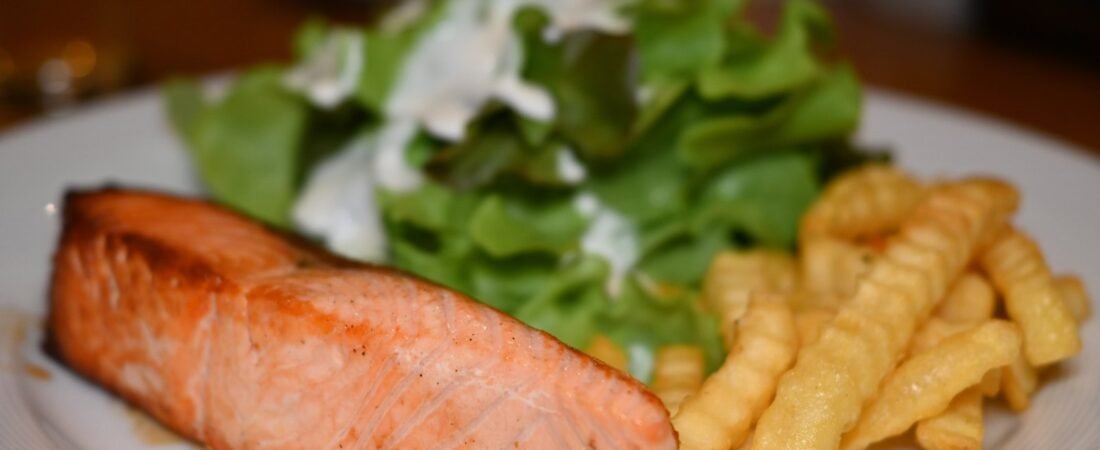
A restaurant-grade salmon fillet is not about a secret ingredient. It is about a dry surface, a properly hot pan, and the discipline to leave the fish alone for five full minutes. Get those three things right and you get shatter-crisp skin, a rosy, just-set centre, and a glossy lemon-garlic butter sauce built in the same pan while the fish rests. Start to finish: twenty-two minutes.
This is the version I cook on a Tuesday when the fridge is nearly empty and on a Saturday when people are coming over. It scales cleanly from one fillet to six, needs no marinating, and the sauce comes together from four things you almost certainly already own.
| Prep time | 10 minutes |
| Cook time | 12 minutes |
| Total time | 22 minutes |
| Serves | 4 |
| Difficulty | Easy, with one moment of nerve |
| Cuisine | Modern European |
| Diet notes | Gluten-free, low-carb, pescatarian |
Why this method works
- Dry skin conducts heat, wet skin steams. Ninety seconds with paper towels is the single highest-return step in the recipe.
- Skin-side down for eighty per cent of the cook. The skin acts as a heat shield, so the flesh cooks gently from below instead of seizing.
- The pan does double duty. The browned bits left behind after searing are the entire flavour base of the sauce. Nothing is wasted and nothing extra is dirtied.
- Cold butter, no heat. Mounting the sauce off the burner keeps the emulsion tight and glossy rather than greasy and separated.
Ingredients
For the salmon
- 4 skin-on salmon fillets, 150-170 g (about 6 oz) each and roughly 2.5 cm (1 inch) thick, centre-cut if you can get it
- 1 tsp fine sea salt
- 1/2 tsp freshly ground black pepper
- 2 tsp neutral high-smoke-point oil, such as grapeseed, rice bran or refined olive oil
For the lemon garlic butter sauce
- 60 g (4 tbsp) unsalted butter, cold, cut into four cubes
- 4 garlic cloves, thinly sliced (not crushed, which burns)
- 60 ml (1/4 cup) dry white wine, or low-sodium chicken or vegetable stock
- 2 tbsp fresh lemon juice, plus 1 tsp finely grated zest
- 1 tbsp capers, drained and rinsed (optional but excellent)
- 2 tbsp flat-leaf parsley, roughly chopped
- A pinch of chilli flakes
To serve
- Lemon wedges
- Flaky sea salt
- Crushed new potatoes, a green salad, or steamed asparagus
Equipment
- A heavy 26-30 cm stainless steel or cast-iron skillet. Non-stick works but browns the skin less aggressively.
- A thin fish spatula. A regular turner will tear the skin off.
- Paper towels, more than you think.
- An instant-read thermometer, if you own one. It turns a judgement call into a fact.
Method
- Temper the fish. Take the fillets out of the fridge 15-20 minutes before cooking. Fridge-cold salmon cooks unevenly, leaving a raw seam through the middle while the outside overcooks.
- Dry it properly. Press paper towels firmly against both sides, paying particular attention to the skin. Repeat with a fresh sheet. The skin should feel tacky, not damp.
- Season at the last second. Salt the fish only when the pan is already hot. Salt applied early pulls moisture back to the surface and undoes the work you just did.
- Heat the pan. Set your skillet over medium-high heat for about 2 minutes, add the oil, and swirl. It is ready when the oil shimmers and moves like water, just before it smokes.
- Lay the fillets skin-side down, away from you. Press each one gently with the back of the spatula for about 10 seconds. This stops the fillet curling as the skin contracts.
- Now leave it alone for 5-6 minutes. Do not poke, lift, or reposition. You will see the flesh turn opaque from the bottom up. When roughly two thirds has changed colour and the fillets release from the pan without resistance, they are ready.
- Flip and finish, 90 seconds to 2 minutes. Pull the salmon at 50 C (125 F) at the thickest point for a medium centre; carryover heat carries it to about 54 C (130 F) while it rests. Prefer it fully opaque? Take it to 57 C (135 F).
- Rest on a warm plate, skin-side up so it stays crisp, tented loosely with foil.
- Start the sauce. Drop the heat to medium-low and pour off all but a thin film of fat. Add one cube of butter and the sliced garlic and cook for 45 seconds, stirring constantly, until fragrant and pale gold. Do not let it brown.
- Deglaze. Pour in the wine or stock and scrape the base of the pan with a wooden spoon to lift every browned speck. Simmer until reduced by half, about 1 minute.
- Mount the butter off the heat. Take the pan off the burner, wait 10 seconds, then whisk in the remaining cold butter one cube at a time, adding the next only when the last has melted. The sauce should thicken slightly and turn glossy.
- Finish and taste. Stir in the lemon juice, zest, capers and chilli flakes. Taste and correct with salt or a squeeze more lemon.
- Serve immediately. Spoon the sauce around rather than over the fillets so the skin stays crisp, then scatter with parsley and flaky salt.
If the skin sticks, it is not ready to move. Salmon releases itself from the pan the moment the crust has formed. Patience is the technique.
Five things that separate good from very good
- Buy thick, buy centre-cut. Tail-end fillets taper and will overcook at the thin end no matter how careful you are.
- Do not crowd the pan. Leave at least 2 cm between fillets. Cook in two batches rather than steaming four fillets in their own moisture.
- Slice the garlic, never crush it. Crushed garlic scorches in a hot pan within seconds and turns the sauce bitter.
- Keep the butter cold and the pan off the heat. This is the difference between a sauce that clings and a pool of oily lemon water.
- Season the sauce last. The pan already holds salt from the fish, and a reduced sauce concentrates it.
Variations and substitutions
| Herby and fresh | Swap parsley for dill and stir 1 tbsp creme fraiche into the finished sauce. |
| Brown butter almond | Skip the wine. Cook the butter to a nutty brown, then add 2 tbsp toasted flaked almonds and the lemon. |
| Miso honey | Whisk 1 tbsp white miso and 2 tsp honey into the deglazing liquid before mounting the butter. |
| Dairy-free | Replace the butter with 3 tbsp good olive oil plus 1 tsp Dijon mustard, whisked hard to emulsify. |
| Other fish | Works as written for sea bass, trout, arctic char and thick cod loin. Reduce the first-side sear to 4 minutes for thinner fillets. |
Make-ahead and storage
- Fridge. Cooked salmon keeps for 2 days in an airtight container. The skin will soften.
- Reheating. Warm gently in a 130 C (265 F) oven for 8-10 minutes. A microwave will turn it chalky.
- The sauce. Make it fresh. A mounted butter sauce splits on reheating and cannot be reliably brought back.
- Cold leftovers. Honestly the better option. Flake into a salad with capers, dill and a squeeze of lemon.
- Freezing. Not recommended once cooked. Freeze raw fillets instead and thaw overnight in the fridge.
Nutrition
| Per serving (approx.) | Amount |
|---|---|
| Calories | 420 kcal |
| Protein | 34 g |
| Total fat | 30 g |
| Saturated fat | 11 g |
| Carbohydrates | 2 g |
| Sugars | 1 g |
| Sodium | 620 mg |
| Omega-3 (EPA + DHA) | 1.8 g |
Figures are estimates calculated for one fillet with a quarter of the sauce, and will vary with the exact cut of fish and brand of butter used.
Frequently asked questions
Skin on or skin off?
Skin on, always, even if you do not intend to eat it. It insulates the flesh, holds the fillet together in the pan, and gives you a crisp texture to play against the sauce. If you dislike it, lift it away after resting; it comes off in one piece.
How do I tell it is done without a thermometer?
Press the thickest part gently with a fingertip. It should feel firm at the edges and still give slightly in the centre. Alternatively, slide a paring knife into the middle for three seconds and touch it to your lower lip: warm means medium, hot means well done.
What can I use instead of wine?
Low-sodium chicken or vegetable stock is the closest match. In a pinch, 60 ml of water with 1 tsp of white wine vinegar does the same job of lifting the fond and adding acidity.
Can I use frozen salmon?
Yes, but thaw it overnight in the fridge on a rack set over a plate, never in warm water, and dry it even more thoroughly than fresh. Frozen fillets hold considerably more surface water.
My sauce split. Can I rescue it?
Usually. Take the pan off the heat, add a tablespoon of cold water or cream, and whisk hard. If that fails, whisk the broken sauce slowly into one fresh cold cube of butter in a clean warm bowl.
Banner photograph by PattayaPatrol, via Wikimedia Commons, licensed under CC BY-SA 4.0.