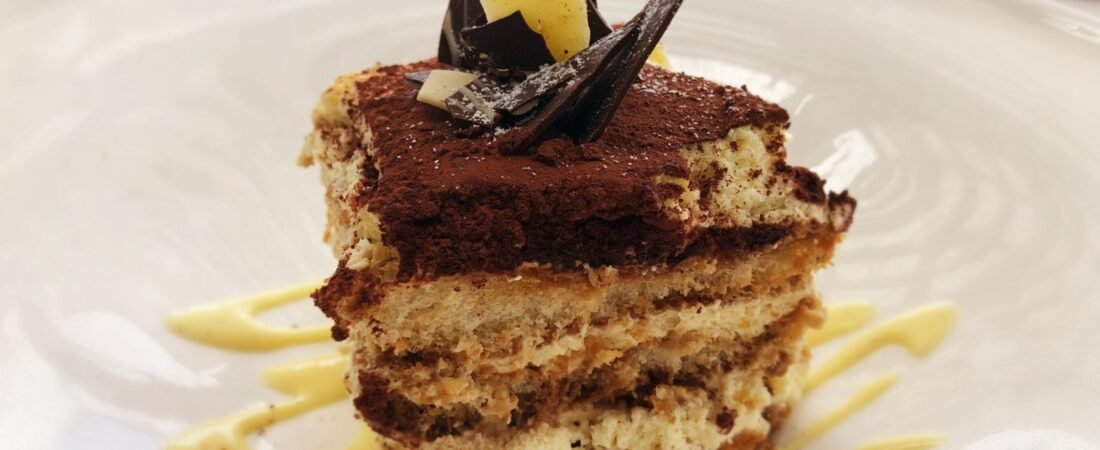
Tiramisu has six ingredients and no oven, which is exactly why it goes wrong so often. There is nothing to hide behind. A soupy base means the biscuits were dipped a second too long; a grainy cream means the mascarpone was whipped like double cream; a bitter, one-note middle means the coffee went in hot. Get the small things right and you get the version people remember: cool, barely sweet, structurally sound enough to cut into squares, and still soft enough to eat with a spoon.
This is the classic Northern Italian method, with the yolks cooked gently over water so the dessert is safe to serve to almost anyone, plus a no-alcohol option that loses nothing.
| Prep time | 30 minutes |
| Cook time | 8 minutes (the zabaglione only) |
| Chilling time | 6 hours minimum, overnight preferred |
| Total time | 6 hours 40 minutes |
| Serves | 9 generous squares |
| Difficulty | Moderate. Nothing is hard, but nothing is forgiving. |
| Cuisine | Italian, Veneto |
| Diet notes | Vegetarian, no-bake, contains uncooked egg white unless you use the cream variation |
The four rules
- The coffee must be cold. Warm coffee melts the biscuit structure on contact and softens the mascarpone from below. Brew it first, before anything else, and let it come down to room temperature or cooler.
- One second per side. Count it out loud. Savoiardi are engineered to absorb fast. They should still feel firm in the middle when you lay them down; they finish softening overnight in the fridge.
- Mascarpone is not cream. It is already around 75 per cent fat and will turn to grainy sweet butter if you beat it. Loosen it with a spatula, then fold. Never take a whisk to it at speed.
- Dust the cocoa at the last possible moment. Cocoa draws in moisture. Applied hours ahead, it turns from a velvet dusting into damp brown patches.
Ingredients
For the cream
- 4 large egg yolks (about 70 g), at room temperature
- 100 g caster sugar
- 2 tbsp water
- 500 g full-fat mascarpone, cold, straight from the fridge
- 4 large egg whites, at room temperature, plus a pinch of fine salt
- Or, for the cream version: 250 ml cold double cream, whipped to soft peaks, in place of the whites
For the soak
- 300 ml strong espresso (about 6 shots) or very strong moka pot coffee, completely cooled
- 3 tbsp dry Marsala, dark rum or coffee liqueur (optional)
- 1 tsp caster sugar, only if your coffee is very bitter
To assemble
- 24-30 Savoiardi ladyfingers, roughly 250 g. Use the hard, dry Italian kind, not soft sponge fingers.
- 30 g good-quality unsweetened cocoa powder
- 20 g dark chocolate, for shaving (optional)
Equipment
- A 20 x 20 cm or 23 x 18 cm straight-sided dish, about 6 cm deep. Glass lets you check the layers.
- A heatproof bowl that sits snugly over a saucepan without touching the water.
- An electric hand whisk. Doing the zabaglione by hand is possible but takes eight minutes of unbroken effort.
- A shallow bowl for the coffee, wide enough to lay a biscuit flat.
- A fine sieve or tea strainer for the cocoa.
Method
Stage one: the zabaglione
- Brew the coffee first and set it aside with the alcohol stirred in, uncovered, to cool completely. In a hurry, spread it in a wide dish or add two ice cubes and accept a slightly weaker soak.
- Set up a bain-marie. Bring 3 cm of water to a bare simmer in a saucepan. The bowl must not touch the water.
- Whisk the yolks, sugar and water in the bowl off the heat until pale, then set it over the pan.
- Whisk continuously for 6-8 minutes until the mixture triples in volume, turns thick and pale, and reaches 71 C on a thermometer. It is ready when a ribbon drizzled from the whisk sits on the surface for three full seconds before sinking.
- Cool it completely. Lift the bowl off, sit it in cold water, and whisk occasionally until it is no warmer than your hand. Warm zabaglione will thin the mascarpone instantly.
Stage two: the cream
- Loosen the mascarpone. Tip it into a wide bowl and work it with a spatula for about 30 seconds, until smooth and spreadable. Stop the moment it is even.
- Fold in the cooled zabaglione in three additions, using a large spatula and a cutting-and-turning motion. Fewer, larger strokes beat many small ones.
- Whip the whites with the pinch of salt to soft peaks: they should hold their shape but the tip should flop over. Stiff, dry peaks leave streaks you cannot fold out. For the cream version, whip the double cream to the same stage.
- Sacrifice a third. Beat one third of the whites into the mascarpone mixture to slacken it, then fold the remaining two thirds through gently until no white streaks remain.
- Check the texture. It should hold a soft peak and fall from the spatula in one slow, heavy ribbon. If it is runny, it has been over-mixed and will not firm up in the fridge.
Stage three: assembly
- Pour the cold coffee into a shallow dish. Working one biscuit at a time, dip flat for one second per side, then lay it sugared-side up in the dish.
- Build the first layer in a single tight row, breaking biscuits to fill the gaps at the ends. Gaps become collapsed corners when you cut.
- Spread half the cream over the top and level it with an offset spatula, pushing it right into the corners.
- Repeat with a second layer of dipped biscuits laid at ninety degrees to the first, which gives cleaner slices, then the remaining cream.
- Smooth the top, cover with cling film held clear of the surface by cocktail sticks, and refrigerate for at least 6 hours. Twelve to twenty-four is better.
- Dust with cocoa just before serving, in two passes through a sieve, then add chocolate shavings if using. Cut with a hot, dry knife, wiping the blade between slices.
Tiramisu made this morning is a good dessert. Tiramisu made last night is a different dessert entirely, because the biscuits have had time to give their moisture back to the cream.
Troubleshooting
| Soupy, will not hold a slice | Biscuits dipped too long, or the coffee was warm. Both are unfixable after the fact. Serve it in glasses and call it a trifle. |
| Grainy or slightly split cream | The mascarpone was whipped, or was worked too hard straight from a very cold fridge. Fold in a tablespoon of cold double cream to bring it back. |
| Dry biscuits in the middle | Under-dipped, or eaten too soon. Another eight hours in the fridge usually solves it. |
| Cocoa gone patchy and wet | Dusted too early. Scrape it off gently and re-dust just before serving. |
| Cream slid off when cut | Not chilled long enough. Six hours is the floor, not the target. |
Variations
- No alcohol. Leave the Marsala out and add 1 tsp vanilla extract to the coffee. Nothing else changes.
- Egg-white free. Use the 250 ml of whipped double cream instead. Slightly richer, slightly denser, and the safest option for pregnancy or young children.
- Pistachio. Fold 80 g of pistachio paste into the mascarpone and finish with chopped pistachios instead of cocoa.
- Berry and limoncello. Swap the coffee for 250 ml of limoncello and lemon syrup, and layer 300 g of macerated raspberries between the biscuits.
- Coffee-free for children. Soak the biscuits in cold chocolate or malted milk. It is not tiramisu, but it disappears faster.
Make-ahead and storage
- Best window. Assemble 12-24 hours ahead. This is a dessert that genuinely wants to be made in advance.
- Fridge. Keeps for 3 days, tightly covered. After that the biscuits break down and the base weeps.
- Freezer. Freezes surprisingly well for up to 1 month, undusted. Thaw overnight in the fridge and dust before serving.
- Transporting. Travel it undusted and flat, with the cling film touching nothing, and dust on arrival.
- Individual portions. Build it in glasses or jars for a party. Timings and quantities are identical and it holds for the same 3 days.
Nutrition
| Per serving (one of nine) | Amount |
|---|---|
| Calories | 430 kcal |
| Protein | 8 g |
| Total fat | 28 g |
| Saturated fat | 16 g |
| Carbohydrates | 34 g |
| Sugars | 21 g |
| Sodium | 95 mg |
| Caffeine | roughly 60 mg |
Estimates for the classic egg-white version without alcohol. The double-cream variation adds roughly 40 kcal per serving.
Frequently asked questions
Is the egg safe?
The yolks here are cooked to 71 C over a bain-marie, the temperature at which salmonella is reliably destroyed. The whites are not cooked. If you are serving anyone pregnant, elderly, very young or immunocompromised, either use pasteurised whites or switch to the whipped double cream version, which is just as good.
Why did my tiramisu turn out runny?
Ninety per cent of the time it is the dip. Savoiardi absorb far faster than they look like they should, and a three-second dip holds roughly three times the liquid of a one-second dip. The other ten per cent is warm coffee, or cream folded until it lost all its air.
Can I use supermarket sponge fingers?
Only if they are the hard, dry, crunchy sort. Soft sponge fingers have a completely different structure and dissolve in the coffee. If in doubt, snap one: it should break with a clean crack.
What coffee should I use?
Espresso is ideal because it is concentrated without being watery. Strong moka pot coffee is the traditional home alternative. Instant works better than most people admit, made at double strength. Filter coffee is usually too dilute unless you brew it deliberately strong.
Can I halve the recipe?
Yes, and it scales cleanly. Use two yolks, two whites, 250 g mascarpone, 50 g sugar and 150 ml coffee in a small loaf tin. The zabaglione is fiddly in such small volumes, so keep the whisk moving.
Banner photograph by Sarah Stierch, via Wikimedia Commons, licensed under CC BY 4.0.